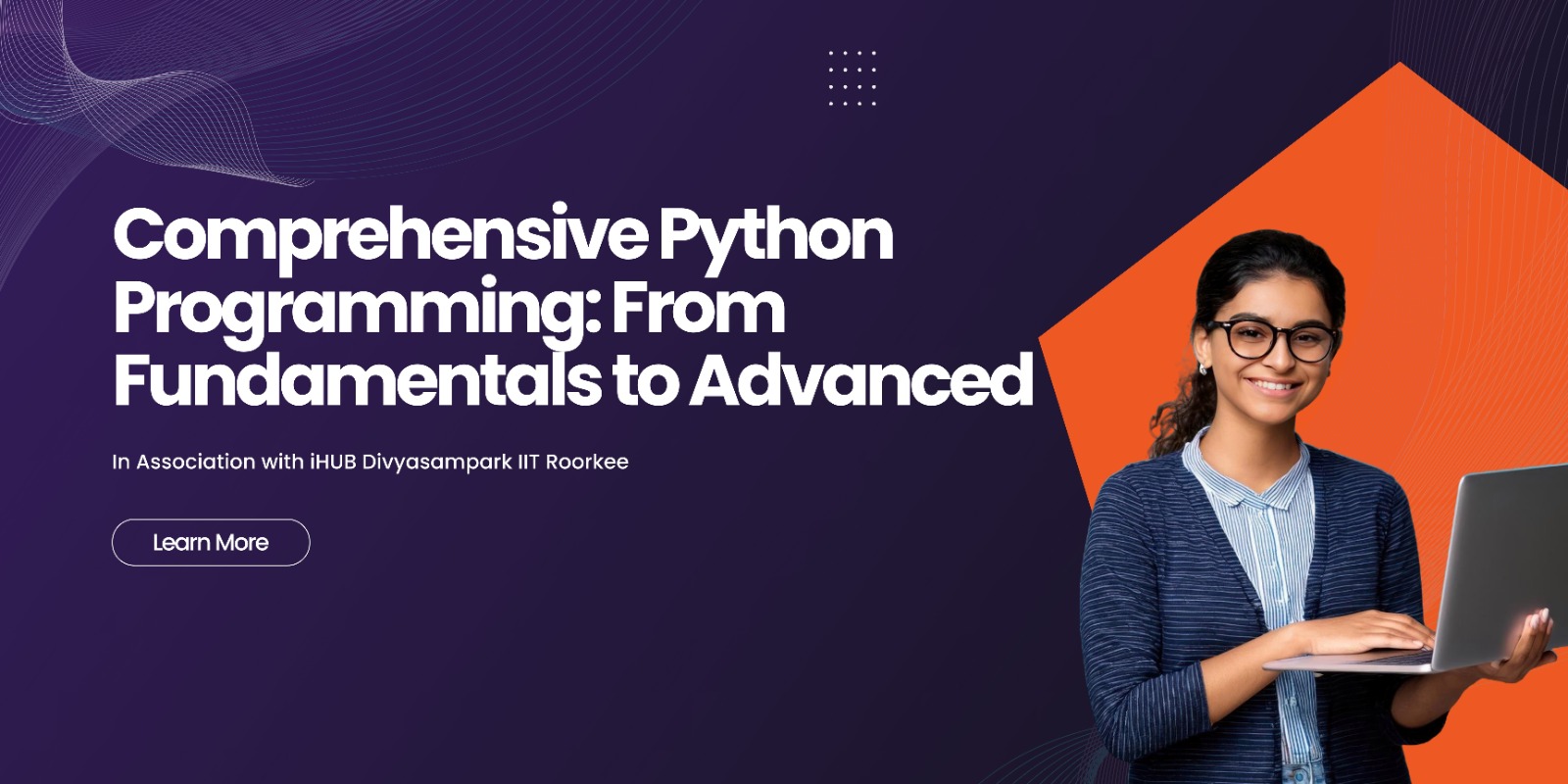
Python for Automation, AI Applications & LLM Integration
(In Association with iHUB Divyasampark IIT Roorkee)
About the Course:
In today’s world of Industrial automation & AI, Python is the most widely used programming language owing to its simplicity, versatility, and an extensive ecosystem. This hands-on, industry-aligned course is designed to build strong Python programming skills for automation, software development, and AI applications.
This course progresses from core Python programming and data structures to advanced programming concepts to real-world application development. Participants will build strong skills in data structures, functions, OOP, decorators, exception handling, file automation, APIs, regular expressions, virtual environments, multithreading, and multiprocessing. The course also introduces Git and GitHub to help participants understand version control, collaborative development, branching, merging and professional software-development workflows.
Through hands-on exercises and real-world projects, participants will develop automation tools, work with files and APIs, build command-line utilities, and create reusable Python components. The course culminates in AI-Assisted Python Development and LLM API Integration, enabling participants to build AI-powered applications using Python.
Course Objectives:
- Build a strong foundation in Python programming by working with core syntax, data types, control flow, strings, data structures, comprehensions, and data processing techniques.
- Develop modular, reusable, and object-oriented Python applications using functions, modules, packages, functional programming, OOP principles such as inheritance, polymorphism, abstraction, and properties.
- Apply advanced Python programming techniques including decorators, lambda and higher-order functions, dunder methods, custom exceptions, and other advanced language features to develop robust applications.
- Automate real-world tasks using Python through file and directory management, data processing, command-line utilities, regular expressions, and practical automation workflows.
- Develop and manage professional Python projects using third-party libraries, pip, virtual environments, dependency management, APIs, HTTP requests, JSON data processing, multithreading, and multiprocessing.
- Adopt professional software development and collaboration practices using Git and GitHub/GitLab for version control, branching, merging, conflict resolution, remote collaboration, and pull requests.
- Leverage AI-assisted Python development tools and LLM APIs such as ChatGPT, GitHub Copilot, Cursor AI, and OpenAI APIs for code generation, debugging, code explanation, problem-solving, and integrating AI capabilities into Python applications.
- Apply the acquired skills to develop industry-oriented Python solutions and a capstone project, including an AI-powered virtual assistant integrating Python with OpenAI and application interfaces.
Batch Details:
Class Timings: 12 noon – 1:30 pm (Saturday & Sunday) Start Date: 31st Oct 2026
Duration: 3 Months (42 Hours) End Date: 07th Feb 2027
Mode: Online Certification: iHUB Divyasampark IIT Roorkee
Last Date to Register: 30th Oct 2026
Course Fee: Rs. 8500/- (Amount inclusive of GST)
Prerequisites and eligibility:
- NO prior knowledge of any Programming Language is necessary for this course.
-
This course can be taken up by any undergraduate/postgraduate student of Basic & Applied Sciences, Engineering, Management and Computer Applications and also by Research Scholars/Faculties/Working Professionals who want to upskill themselves.
-
Participants need to have a laptop/PC (with a minimum of 4 GB RAM, 100 GB HDD, Intel i3 processor) and proper internet/Wi-Fi connection.
Course Overview:
Module 1: Python Fundamentals & Data Structures
- Introduction to Python: Applications, installation, development environments, syntax, indentation and comments
- Variables & Data Types: Variables, constants, numbers, strings, Boolean values, type conversion and type checking
- Operators & Expressions: Arithmetic, relational, logical, assignment and other operators; expressions
- Input & Output: User input, formatted output and basic input/output operations
- Control Flow & Loops: if, elif, else, nested conditions, for and while loops, break, continue and pass
- Strings: String creation, indexing, slicing, methods and common string operations
- Lists & Tuples: List creation and methods, tuple creation and operations, indexing, slicing and nested sequences
- Sets & Dictionaries: Set creation and operations; dictionaries, dictionary methods, nested data structures
- Comprehensions & Iteration: List, set and dictionary comprehensions; iterating over Python data structures
- Data Processing Operations: Sorting, searching and practical manipulation of Python data structures
- Important Object Concepts: Mutable vs. immutable objects and their practical implications
- Hands-on: Basic Programming Problems & Data processing using Python
.·
Module 2: Functions, Modular Programming & Object-Oriented Programming
- Functions: Defining and calling functions, arguments and return values, positional and keyword arguments, default and variable-length arguments, *args and **kwargs
- Functional Programming: Lambda functions, map(), filter(), reduce() and recursion
- Variable Scope: Local, global and nonlocal variables; scope and lifetime of variables
- Modules & Packages: Importing modules, creating user-defined modules, packages and package structures, Python standard library
- Introduction to OOP: Object-oriented programming concepts, classes, objects, attributes, methods, constructors and destructors
- Methods & Encapsulation: Instance, class and static methods; encapsulation, properties and decorators
- Inheritance: Inheritance concepts and types of inheritance; method overriding
- Polymorphism & Abstraction: Polymorphism, abstract classes and interfaces
- Hands-on: Developing a Modular Object-Oriented Python Application
Module 3: Advanced Python Programming
- Advanced Functions & Decorators: Function decorators, wrapper functions, nested functions, decorators with arguments, decorator syntax and practical use cases such as logging, timing, authentication, caching and rate limiting
- OOP-Advanced Concepts: Getters and setters, @property, property setters, encapsulation and creating computed properties
- Methods in Python Classes: Instance methods, static methods using @staticmethod, class methods using @classmethod, class attributes and instance attributes
- Magic/Dunder Methods: Double-underscore methods, __init__, __str__, __repr__, __len__ and customizing object behavior through special methods
- Exception Handling: Handling errors using try, except, else and finally; handling specific exceptions, accessing exception information and raising custom exceptions with raise
- Functional Programming: Higher-order functions, map(), filter(), reduce() and applying functions to Iterables
- Lambda Functions: Creating anonymous functions and using lambda expressions with map(), filter() and other functional programming patterns
- Walrus Operator: Assignment expressions using :=; assigning and using values within expressions, reducing repeated calculations and simplifying loops and conditional expressions
- Hands-on Project: Advanced Python Automation using Decorators, OOP, Functional Programming and Exception Handling
Module 4: File Handling, Data Processing & Automation
- File I/O & File Operations: Reading, writing and appending files; file modes, line-by-line file processing, file pointers, read()/write() operations and context managers using with statement.
- File & Directory Management: Listing, checking, copying, moving and deleting files and directories using os and shutil
- File & Directory Automation: Automating file and directory management tasks, including organizing files by type and working with nested directories
- Command-Line Utilities: Creating command-line tools using Python's argparse module; command-line arguments, argument types, help messages, choices and argument parsing
- Command-Line Automation: Building Python scripts that accept user inputs and perform operations directly from the terminal
- Error Handling in File Operations: Handling missing files, invalid paths and file-related errors using exceptions and try-except
- Hands-on Project: Automated File Management / Command-Line Utility
Module 5: Python Libraries, Packages, APIs & Virtual Environment
- Python Libraries & Modules: Python Standard Library, built-in modules, importing modules and packages, external/third-party libraries, package documentation and module usage.
- Package Management: Installing, upgrading, uninstalling and managing third-party packages using pip; checking installed packages with pip list; installing specific package versions.
- Virtual Environments: Creating, activating and deactivating isolated Python environments; managing project-specific dependencies and package versions.
- Dependency Management: Generating and using requirements.txt; freezing package versions with pip freeze; installing project dependencies with pip install -r
- APIs & HTTP Requests: Using the requests library to make GET and POST requests, retrieving data from URLs, sending request data and working with different HTTP request methods
- API Data Processing: Processing text and JSON responses from external APIs and saving API responses to files
- Regular Expressions: Pattern matching and text processing using Python's re module; searching, finding multiple matches, case-insensitive matching and replacing patterns
- Multithreading & Parallel Execution: Thread-based parallel execution for I/O-bound tasks; creating and starting threads, passing arguments, using join() and understanding the Global Interpreter Lock (GIL)
- Multiprocessing: Introduction to multiprocessing for CPU-bound tasks and understanding when multiprocessing is preferred over multithreading
- Hands-on Project: Developing a Reusable API Integration Tool with Dependency Management, Regular Expression Processing and Parallel Execution
Module 6: Version Control: Git for Developers
- Git Fundamentals: Version control concepts, Git workflow, repositories, installation and configuration
- Repository Management: Creating and cloning repositories, .gitignore, repository structure and remote repositories
- Tracking & Managing Changes: Working directory, staging area, commits, git status, git add, git diff and commit history
- Branching & Merging: Creating and managing branches, merging, resolving merge conflicts and basic branching strategies
- Remote Collaboration: GitHub/GitLab, push, pull, fetch, pull requests and collaborative development
- Undoing & Recovering Changes: restore, reset, revert, stash, tags and version recovery
- Hands-on: Managing and Collaborating on a Python Project using Git & GitHub
Module 7: AI-assisted Python Development & Capstone Project
- AI-Assisted Python Development: When and how to use AI tools effectively for Python programming, debugging, code explanation and problem-solving
- AI Coding Assistants: Practical use of ChatGPT, GitHub Copilot, Cursor AI and other AI-powered coding assistants for Python development
- Working with LLM APIs: Introduction to LLM APIs, API requests, authentication, prompts, response handling and integrating LLM capabilities into Python applications
- Capstone Project: Build an AI-powered virtual assistant using Python and OpenAI. Create a chatbot with an API key, chat completions, and web or mobile app integrations.
Contact Person: Dr. Subrat Kotoky
Email: [email protected] / [email protected]
Phone: 9085317465 / 8473874389
Expert Profile: Mr. Shreyas Shukla
- Senior AI Engineer at Pfizer through Toptal (Freelance) & Professional Corporate Trainer
- MTech-IIT Kharagpur & BE- The Aeronautical Society of India, New Delhi
- 4+ years of experience in leading online professional courses for different leading Organization
- Has successfully conducted 25+ courses and trained 2000+ learners in the fields of Python Programming, Data Analytics, Machine Learning, Data Science, Database Management, Deep Learning, Computer Vision, Generative AI etc. till now.
Register Now
.jpg)







.jpg)



.jpg)
.jpg)

Share this Page!